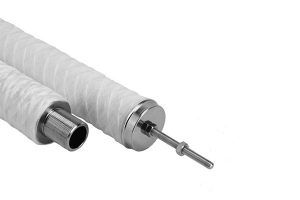
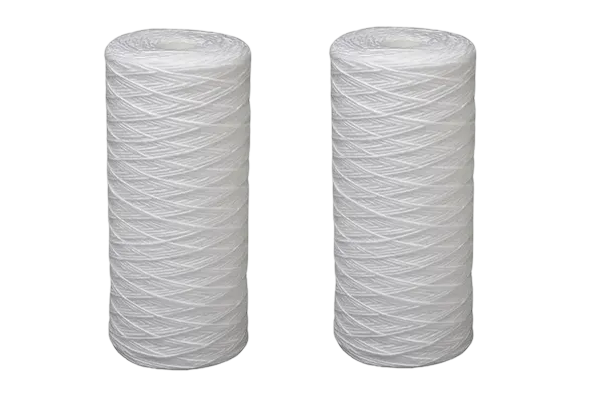
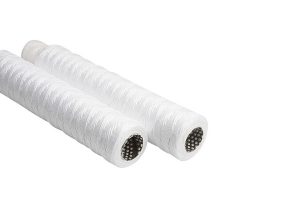
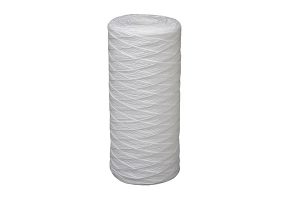
Cartuchos filtrantes String Wound

Built for demanding process environments where particulate loading is high. String wound cartridges use layered yarn construction to achieve graded depth filtration across 1–100 microns, ensuring stable performance and extended service life.

In-house Lab Testing

ISO 9001 Certified

Global Delivery

Need Help Selecting?

Our engineers can help you choose the right filter for your application

Cartuchos filtrantes de membrana

3

Understanding String Wound Filtration

String-wound filtration uses layers of tightly wound yarn to create a true depth-filtration structure. This graded density design captures larger particles near the surface while trapping finer contaminants deeper within the cartridge.

Their robust construction delivers high dirt-holding capacity and reliable performance in demanding industrial environments.

Key Benefits

  • Graded depth capture
  • High solids capacity
  • Strong pressure tolerance
  • Reliable prefiltration

Need Help Selecting?

Our engineers can help you choose the right filter for your application

Why Choose Pullner Filter?

Más que un simple proveedor: somos su socio técnico en soluciones de filtración

Laboratory and Testing Facilities

In-house testing capabilities for materials and quality assurance with advanced equipment and certified technicians.


  • Particle counting analysis
  • Pressure drop testing
    Material
  • compatibility testing

Design and R&D Services

Position as technical partner, not just supplier. Custom solutions for your unique challenges.

  • Custom filter design
  • System optimization
  • Technical consultation

Free Services

Comprehensive free services to support your filtration needs without any hidden costs.


  • Free testing for filtration systems
  • Free custom filtration design
  • Up to 2 free samples

Global Manufacturing

State-of-the-art manufacturing facilities with worldwide delivery capabilities and local support.

  • ISO 9001 certified facilities
  • Global logistics network
  • Local technical support

Resultados reales con los filtros de alto caudal Pullner: Casos prácticos

Vea cómo nuestros cartuchos de alta capacidad ayudan a clientes de todo el mundo a reducir costes, aumentar los caudales y mejorar el rendimiento de la filtración en todos los sectores.

Custom Composite String Wound Filter Cartridge for Power Plant Condensate Polishing: Huaneng Group Gansu Power Plant

Condensate polishing is one of the most technically demanding filtration applications in power generation.

Preguntas frecuentes

A string wound filter cartridge is a depth filtration device made by tightly winding high-performance fibers (polypropylene, cotton, or glass fiber) around a central core (PP or stainless steel). The gradient density structure (loose outside, tight inside) provides high dirt holding capacity and removes particles from 1-50μm.

Key features:

  • Filtration precision: 1μm, 5μm, 10μm, 20μm, 50μm
  • Lengths available: 10″, 20″, 30″, 40″, 60″, 70″ (up to 1778mm)
  • Materials: Polypropylene (PP), Cotton, Glass Fiber, Polyester
  • Core types: PP (standard) or Stainless Steel 304/316L (high temp/pressure)
  • Max temperature: Up to 250°C (depending on material)
  • Aplicaciones: Power plants, RO pre-filtration, food/beverage, chemicals, pharmaceuticals

String wound filter cartridges are classified by fiber material, core type, and application:

By fiber material:

  • Polypropylene (PP): Most common, cost-effective, wide chemical compatibility
  • Cotton: Better dirt holding capacity, suitable for food/beverage
  • Glass Fiber: High temperature resistance, power plant condensate filtration
  • Polyester: Oil and solvent filtration
  • Nylon: High strength, chemical resistance

By core type:

  • PP core: Standard applications up to 90°C
  • SS304 core: High temperature/pressure applications
  • SS316L core: Corrosive chemicals, seawater desalination

By product type:

  • PLX Standard String Wound Filter (10″-40″)
  • PHFX Power Plant Iron Removal Filter (up to 70″)
  • Big Size 114mm String Wound Filter (high flow applications)

String wound filters work through gradient density depth filtration. The yarn is wound with a honeycomb pattern that creates tight inner layers and loose outer layers, trapping particles progressively from coarse to fine as liquid flows from inside to outside.

Filtration process:

  1. Entry: Liquid enters the filter core under pressure
  2. Layer-by-layer filtration: Larger particles trapped in outer (loose) layers, smaller particles captured in inner (tight) layers
  3. Progressive capture: Gradient density structure maximizes dirt holding capacity
  4. Clean output: Filtered liquid exits with particles removed down to the rated micron size

Key advantage: The winding pattern creates thousands of independent filtration channels (e.g., 1,530 channels for a 20μm filter, 4,914 channels for a 3μm filter), allowing high flow rates with low pressure drop.

String wound filters offer high dirt holding capacity, exceptional mechanical strength, large flow rates, and long service life. They’re cost-effective, resist pressure differentials, and suitable for diverse filtration applications.

Key advantages:

  • High dirt holding capacity: Gradient density traps more particles before replacement needed
  • Exceptional mechanical strength: Withstands high pressure (up to 3.0 bar) without deformation
  • Large flow capacity: Thousands of independent channels enable high flow with low pressure drop
  • Long service life: Depth filtration extends lifespan vs. surface filters
  • Temperature resistant: Up to 250°C (with SS core and glass fiber)
  • Cost-effective: Lower cost than membrane filters for pre-filtration applications
  • Chemically compatible: Available in materials for acids, alkalis, oils, and solvents
  • Custom lengths: Up to 70″ (1778mm) for high flow/high contaminant applications

String wound filter cartridges are used in power plants (condensate iron removal), RO pre-filtration, food/beverage (beer, juice), chemicals/petrochemicals (acids, oils, solvents), pharmaceuticals (injections, syrups), and electronics (pure water, cleaning liquids).

Power plant applications:

  • Condensate water filtration and iron removal
  • Resin pre-coat filtration
  • Desalination pretreatment

Food & beverage:

  • Mineral water, beverage process filtration
  • Syrup, alcohol, edible oil filtration

Chemical & petrochemical:

  • RO/DI pre-filtration
  • Paints, coatings, inks, photosensitive liquids
  • Acids, alkalis, organic solvents

Industria electrónica:

  • Pure water and organic solvent filtration
  • Electroplating, printed circuit boards

Industria farmacéutica:

  • Syrup, alcohol, preparation water
  • Injections and antibiotic solutions

Industrial oils:

  • Hydraulic oil, lubricating oil, cutting oil filtration

Choose based on: (1) filtration precision needed (1-50μm), (2) fiber material for your liquid type, (3) core material for temperature/pressure, and (4) length for flow rate requirements. Verify the filter has proper winding pattern (no blind holes) and correct dimensions.

Selection criteria:

  • Filtration precision: 1-5μm (fine particles), 10-20μm (general pre-filtration), 20-50μm (coarse sediment)
  • Fiber material: PP (general use, chemicals), Cotton (food/beverage), Glass Fiber (high temp power plants)
  • Core material: PP core (up to 90°C), SS304 (high temp/pressure), SS316L (seawater, corrosive chemicals)
  • Longitud: 10″-40″ (standard flow), 60″-70″ (high flow/high dirt capacity applications)

Quality checks:

  • Verify filter holes are penetrated (no blind holes from poor winding)
  • Check inner/outer diameter meets specifications (not reduced to save costs)
  • Confirm proper materials to avoid corrosion
  • Use SS304 core for power plant condensate (not PP)

Monitor differential pressure and replace when it reaches 1.5-2.1 bar above baseline. Prevent particulate matter from bypassing pre-filters. For cleanable filters, use backwashing or chemical cleaning (for compatible materials), but replacement is recommended for best performance.

Maintenance guidelines:

  • Pressure monitoring: Replace when differential pressure (ΔP) reaches 1.5-2.1 bar
  • Pre-filtration: Install coarse filters upstream to extend string wound filter life
  • Regular inspection: Check for physical damage or corrosion after extended use
  • Cleaning (limited applications): Backwash with water/compressed air or chemical cleaning (ultrasonic or dilute acid for acid-soluble contaminants)
  • Replacement recommended: String wound filters are typically disposable; cleaning may not restore full filtration efficiency

For power plant condensate filters (PHFX):

  • Monitor resin coating integrity
  • Replace if polypropylene fiber falls off or core deforms
  • Ensure SS304 core withstands backflush process without damage

Storage: Keep filters in original packaging in dry, clean environment until installation.

Yes, a 5 micron (or smaller) string wound filter can remove iron particles if the iron has settled into particulate form. It removes ferrous solid impurities but not dissolved iron. For power plant condensate, use PHFX series filters with resin coating for effective iron removal and desalination.

Iron removal capabilities:

  • Particulate iron: 5μm or smaller filters remove majority of iron particles
  • Dissolved iron: Requires water softener or chemical treatment (filters cannot remove dissolved iron)
  • Water softener limit: Removes up to 4 PPM of iron, but resin needs monthly cleaning

For power plants: PHFX series (up to 70″) with resin coating effectively reduces ferrous impurities in condensate water, protecting downstream resin from contamination.

A 5 micron sediment filter means the filter can capture particles as small as 5 microns (0.005mm). This micron rating indicates the filter’s capability to remove contaminants by particle size, suitable for removing fine sediment, rust, and suspended solids from liquids.

Micron rating explained:

  • 1 micron: Removes bacteria and fine particles (bacteria range 0.2-2 microns)
  • 5 micron: Removes fine sediment, rust particles, most bacteria
  • 10 micron: Removes sand, silt, general sediment
  • 20-50 micron: Removes coarse sediment, pre-filtration applications

Context: Smaller micron = finer filtration. A 5 micron filter has smaller openings than a 20 micron filter.

A 1 micron filter provides finer filtration than a 5 micron filter and can remove most bacteria and cysts (bacteria range 0.2-10 microns). However, “better” depends on your application: 1 micron clogs faster with high sediment loads, while 5 micron offers longer life for pre-filtration.

Comparison:

  • 1 micron: Removes most bacteria/cysts, finer filtration, faster clogging, best for final polishing or low-sediment water
  • 5 micron: Removes fine sediment and most bacteria, longer service life, better for pre-filtration or high sediment loads

Selection guide:

  • Use 1 micron: Final filtration, bacteria removal, low-sediment applications
  • Use 5 micron: RO pre-filtration, general sediment removal, high dirt capacity needed
  • Multi-stage approach: Use 5 micron upstream + 1 micron downstream for best results
pullner cta

Hable con nuestro experto en filtración

Póngase en contacto con nuestro equipo de expertos para obtener soluciones de filtración personalizadas

Scroll al inicio
Ir arriba Actualizar preferencias de cookies

Hable con nuestros ingenieros

Cumplimentación de formularios
0%