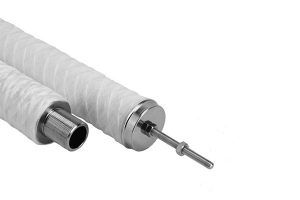
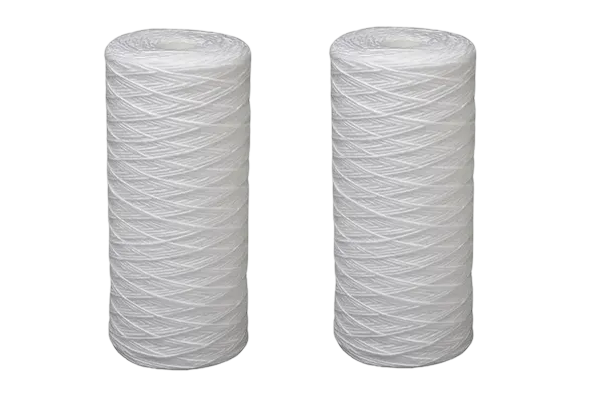
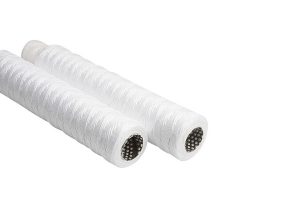
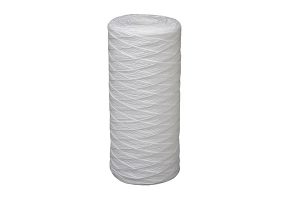
خراطيش الترشيح ذات الجرح الخيطي

Built for demanding process environments where particulate loading is high. String wound cartridges use layered yarn construction to achieve graded depth filtration across 1–100 microns, ensuring stable performance and extended service life.

In-house Lab Testing

ISO 9001 Certified

Global Delivery

Need Help Selecting?

Our engineers can help you choose the right filter for your application

Understanding String Wound Filtration

String-wound filtration uses layers of tightly wound yarn to create a true depth-filtration structure. This graded density design captures larger particles near the surface while trapping finer contaminants deeper within the cartridge.

Their robust construction delivers high dirt-holding capacity and reliable performance in demanding industrial environments.

Key Benefits

  • Graded depth capture
  • High solids capacity
  • Strong pressure tolerance
  • Reliable prefiltration

Need Help Selecting?

Our engineers can help you choose the right filter for your application

لماذا تختار فلتر بولنر؟

نحن أكثر من مجرد مورد - نحن شريكك التقني في حلول الترشيح

مرافق المختبرات والاختبارات

قدرات اختبار داخلية للمواد وضمان الجودة مع معدات متطورة وفنيين معتمدين.

  • تحليل عد الجسيمات
  • اختبار انخفاض الضغط
    المواد
  • اختبار التوافق

خدمات التصميم والبحث والتطوير

وضعك كشريك تقني وليس مجرد مورد. حلول مخصصة لتحدياتك الفريدة من نوعها.

  • تصميم فلتر مخصص
  • تحسين النظام
  • الاستشارات الفنية

الخدمات المجانية

خدمات مجانية شاملة لدعم احتياجاتك من الترشيح دون أي تكاليف خفية.

  • اختبار مجاني لأنظمة الترشيح
  • تصميم الترشيح المخصص المجاني
  • ما يصل إلى 2 عينات مجانية

التصنيع العالمي

منشآت تصنيع متطورة مزودة بأحدث مرافق التصنيع مع إمكانات توصيل عالمية ودعم محلي.

  • منشآت حاصلة على شهادة الأيزو 9001
  • شبكة الخدمات اللوجستية العالمية
  • الدعم الفني المحلي

نتائج حقيقية مع فلاتر بولنر عالية التدفق: دراسات حالة

شاهد كيف تساعد خراطيشنا عالية السعة عملاءنا العالميين على خفض التكاليف وزيادة معدلات التدفق وتحسين أداء الترشيح في مختلف الصناعات.

Custom Composite String Wound Filter Cartridge for Power Plant Condensate Polishing: Huaneng Group Gansu Power Plant

Condensate polishing is one of the most technically demanding filtration applications in power generation.

الأسئلة الشائعة

A string wound filter cartridge is a depth filtration device made by tightly winding high-performance fibers (polypropylene, cotton, or glass fiber) around a central core (PP or stainless steel). The gradient density structure (loose outside, tight inside) provides high dirt holding capacity and removes particles from 1-50μm.

Key features:

  • Filtration precision: 1μm, 5μm, 10μm, 20μm, 50μm
  • Lengths available: 10″, 20″, 30″, 40″, 60″, 70″ (up to 1778mm)
  • Materials: Polypropylene (PP), Cotton, Glass Fiber, Polyester
  • Core types: PP (standard) or Stainless Steel 304/316L (high temp/pressure)
  • Max temperature: Up to 250°C (depending on material)
  • التطبيقات: Power plants, RO pre-filtration, food/beverage, chemicals, pharmaceuticals

String wound filter cartridges are classified by fiber material, core type, and application:

By fiber material:

  • Polypropylene (PP): Most common, cost-effective, wide chemical compatibility
  • Cotton: Better dirt holding capacity, suitable for food/beverage
  • Glass Fiber: High temperature resistance, power plant condensate filtration
  • Polyester: Oil and solvent filtration
  • Nylon: High strength, chemical resistance

By core type:

  • PP core: Standard applications up to 90°C
  • SS304 core: High temperature/pressure applications
  • SS316L core: Corrosive chemicals, seawater desalination

By product type:

  • PLX Standard String Wound Filter (10″-40″)
  • PHFX Power Plant Iron Removal Filter (up to 70″)
  • Big Size 114mm String Wound Filter (high flow applications)

String wound filters work through gradient density depth filtration. The yarn is wound with a honeycomb pattern that creates tight inner layers and loose outer layers, trapping particles progressively from coarse to fine as liquid flows from inside to outside.

Filtration process:

  1. Entry: Liquid enters the filter core under pressure
  2. Layer-by-layer filtration: Larger particles trapped in outer (loose) layers, smaller particles captured in inner (tight) layers
  3. Progressive capture: Gradient density structure maximizes dirt holding capacity
  4. Clean output: Filtered liquid exits with particles removed down to the rated micron size

Key advantage: The winding pattern creates thousands of independent filtration channels (e.g., 1,530 channels for a 20μm filter, 4,914 channels for a 3μm filter), allowing high flow rates with low pressure drop.

String wound filters offer high dirt holding capacity, exceptional mechanical strength, large flow rates, and long service life. They’re cost-effective, resist pressure differentials, and suitable for diverse filtration applications.

Key advantages:

  • High dirt holding capacity: Gradient density traps more particles before replacement needed
  • Exceptional mechanical strength: Withstands high pressure (up to 3.0 bar) without deformation
  • Large flow capacity: Thousands of independent channels enable high flow with low pressure drop
  • Long service life: Depth filtration extends lifespan vs. surface filters
  • Temperature resistant: Up to 250°C (with SS core and glass fiber)
  • Cost-effective: Lower cost than membrane filters for pre-filtration applications
  • Chemically compatible: Available in materials for acids, alkalis, oils, and solvents
  • Custom lengths: Up to 70″ (1778mm) for high flow/high contaminant applications

String wound filter cartridges are used in power plants (condensate iron removal), RO pre-filtration, food/beverage (beer, juice), chemicals/petrochemicals (acids, oils, solvents), pharmaceuticals (injections, syrups), and electronics (pure water, cleaning liquids).

Power plant applications:

  • Condensate water filtration and iron removal
  • Resin pre-coat filtration
  • Desalination pretreatment

Food & beverage:

  • Mineral water, beverage process filtration
  • Syrup, alcohol, edible oil filtration

Chemical & petrochemical:

  • RO/DI pre-filtration
  • Paints, coatings, inks, photosensitive liquids
  • Acids, alkalis, organic solvents

صناعة الإلكترونيات:

  • Pure water and organic solvent filtration
  • Electroplating, printed circuit boards

صناعة المستحضرات الصيدلانية:

  • Syrup, alcohol, preparation water
  • Injections and antibiotic solutions

Industrial oils:

  • Hydraulic oil, lubricating oil, cutting oil filtration

Choose based on: (1) filtration precision needed (1-50μm), (2) fiber material for your liquid type, (3) core material for temperature/pressure, and (4) length for flow rate requirements. Verify the filter has proper winding pattern (no blind holes) and correct dimensions.

Selection criteria:

  • Filtration precision: 1-5μm (fine particles), 10-20μm (general pre-filtration), 20-50μm (coarse sediment)
  • Fiber material: PP (general use, chemicals), Cotton (food/beverage), Glass Fiber (high temp power plants)
  • Core material: PP core (up to 90°C), SS304 (high temp/pressure), SS316L (seawater, corrosive chemicals)
  • الطول: 10″-40″ (standard flow), 60″-70″ (high flow/high dirt capacity applications)

Quality checks:

  • Verify filter holes are penetrated (no blind holes from poor winding)
  • Check inner/outer diameter meets specifications (not reduced to save costs)
  • Confirm proper materials to avoid corrosion
  • Use SS304 core for power plant condensate (not PP)

Monitor differential pressure and replace when it reaches 1.5-2.1 bar above baseline. Prevent particulate matter from bypassing pre-filters. For cleanable filters, use backwashing or chemical cleaning (for compatible materials), but replacement is recommended for best performance.

Maintenance guidelines:

  • Pressure monitoring: Replace when differential pressure (ΔP) reaches 1.5-2.1 bar
  • Pre-filtration: Install coarse filters upstream to extend string wound filter life
  • Regular inspection: Check for physical damage or corrosion after extended use
  • Cleaning (limited applications): Backwash with water/compressed air or chemical cleaning (ultrasonic or dilute acid for acid-soluble contaminants)
  • Replacement recommended: String wound filters are typically disposable; cleaning may not restore full filtration efficiency

For power plant condensate filters (PHFX):

  • Monitor resin coating integrity
  • Replace if polypropylene fiber falls off or core deforms
  • Ensure SS304 core withstands backflush process without damage

Storage: Keep filters in original packaging in dry, clean environment until installation.

Yes, a 5 micron (or smaller) string wound filter can remove iron particles if the iron has settled into particulate form. It removes ferrous solid impurities but not dissolved iron. For power plant condensate, use PHFX series filters with resin coating for effective iron removal and desalination.

Iron removal capabilities:

  • Particulate iron: 5μm or smaller filters remove majority of iron particles
  • Dissolved iron: Requires water softener or chemical treatment (filters cannot remove dissolved iron)
  • Water softener limit: Removes up to 4 PPM of iron, but resin needs monthly cleaning

For power plants: PHFX series (up to 70″) with resin coating effectively reduces ferrous impurities in condensate water, protecting downstream resin from contamination.

A 5 micron sediment filter means the filter can capture particles as small as 5 microns (0.005mm). This micron rating indicates the filter’s capability to remove contaminants by particle size, suitable for removing fine sediment, rust, and suspended solids from liquids.

Micron rating explained:

  • 1 micron: Removes bacteria and fine particles (bacteria range 0.2-2 microns)
  • 5 micron: Removes fine sediment, rust particles, most bacteria
  • 10 micron: Removes sand, silt, general sediment
  • 20-50 micron: Removes coarse sediment, pre-filtration applications

Context: Smaller micron = finer filtration. A 5 micron filter has smaller openings than a 20 micron filter.

A 1 micron filter provides finer filtration than a 5 micron filter and can remove most bacteria and cysts (bacteria range 0.2-10 microns). However, “better” depends on your application: 1 micron clogs faster with high sediment loads, while 5 micron offers longer life for pre-filtration.

Comparison:

  • 1 micron: Removes most bacteria/cysts, finer filtration, faster clogging, best for final polishing or low-sediment water
  • 5 micron: Removes fine sediment and most bacteria, longer service life, better for pre-filtration or high sediment loads

Selection guide:

  • Use 1 micron: Final filtration, bacteria removal, low-sediment applications
  • Use 5 micron: RO pre-filtration, general sediment removal, high dirt capacity needed
  • Multi-stage approach: Use 5 micron upstream + 1 micron downstream for best results
pullner cta

تحدث إلى خبير الترشيح لدينا

تواصل مع فريق الخبراء لدينا للحصول على حلول الترشيح المخصصة

انتقل إلى الأعلى
انتقل إلى أعلى تحديث تفضيلات ملفات تعريف الارتباط

تحدث إلى مهندسينا

إكمال النموذج
0%