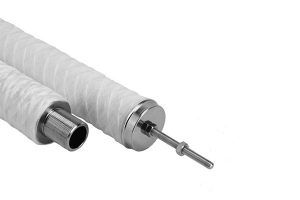
Cartucho filtrante bobinado PHFX para eliminación de hierro en centrales eléctricas
- Flow Rate:
- 500 GPM
- Micron:
- 5, 10, 25 μm
- Temp:
- up to 80°C
Trustpilot
Built for demanding process environments where particulate loading is high. String wound cartridges use layered yarn construction to achieve graded depth filtration across 1–100 microns, ensuring stable performance and extended service life.
In-house Lab Testing
ISO 9001 Certified
Global Delivery
Need Help Selecting?
Our engineers can help you choose the right filter for your application
String-wound filtration uses layers of tightly wound yarn to create a true depth-filtration structure. This graded density design captures larger particles near the surface while trapping finer contaminants deeper within the cartridge.
Their robust construction delivers high dirt-holding capacity and reliable performance in demanding industrial environments.
Need Help Selecting?
Our engineers can help you choose the right filter for your application
Más que un simple proveedor: somos su socio técnico en soluciones de filtración
In-house testing capabilities for materials and quality assurance with advanced equipment and certified technicians.
Position as technical partner, not just supplier. Custom solutions for your unique challenges.
Comprehensive free services to support your filtration needs without any hidden costs.
State-of-the-art manufacturing facilities with worldwide delivery capabilities and local support.
Vea cómo nuestros cartuchos de alta capacidad ayudan a clientes de todo el mundo a reducir costes, aumentar los caudales y mejorar el rendimiento de la filtración en todos los sectores.
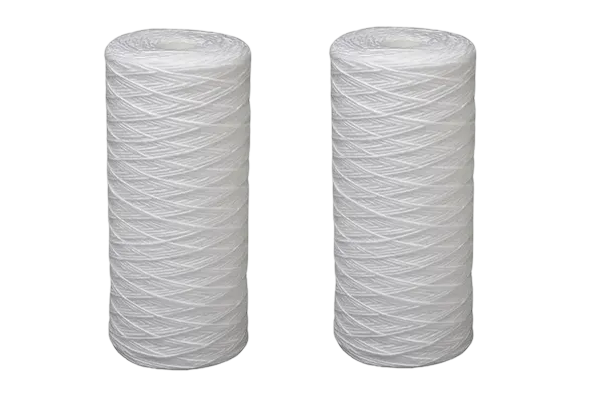
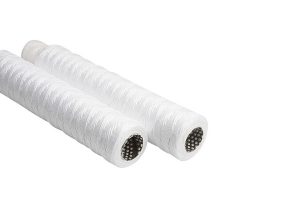
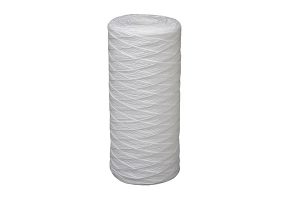
A string wound filter cartridge is a depth filtration device made by tightly winding high-performance fibers (polypropylene, cotton, or glass fiber) around a central core (PP or stainless steel). The gradient density structure (loose outside, tight inside) provides high dirt holding capacity and removes particles from 1-50μm.
Key features:
String wound filter cartridges are classified by fiber material, core type, and application:
By fiber material:
By core type:
By product type:
String wound filters work through gradient density depth filtration. The yarn is wound with a honeycomb pattern that creates tight inner layers and loose outer layers, trapping particles progressively from coarse to fine as liquid flows from inside to outside.
Filtration process:
Key advantage: The winding pattern creates thousands of independent filtration channels (e.g., 1,530 channels for a 20μm filter, 4,914 channels for a 3μm filter), allowing high flow rates with low pressure drop.
String wound filters offer high dirt holding capacity, exceptional mechanical strength, large flow rates, and long service life. They’re cost-effective, resist pressure differentials, and suitable for diverse filtration applications.
Key advantages:
String wound filter cartridges are used in power plants (condensate iron removal), RO pre-filtration, food/beverage (beer, juice), chemicals/petrochemicals (acids, oils, solvents), pharmaceuticals (injections, syrups), and electronics (pure water, cleaning liquids).
Power plant applications:
Food & beverage:
Chemical & petrochemical:
Industria electrónica:
Industria farmacéutica:
Industrial oils:
Choose based on: (1) filtration precision needed (1-50μm), (2) fiber material for your liquid type, (3) core material for temperature/pressure, and (4) length for flow rate requirements. Verify the filter has proper winding pattern (no blind holes) and correct dimensions.
Selection criteria:
Quality checks:
Monitor differential pressure and replace when it reaches 1.5-2.1 bar above baseline. Prevent particulate matter from bypassing pre-filters. For cleanable filters, use backwashing or chemical cleaning (for compatible materials), but replacement is recommended for best performance.
Maintenance guidelines:
For power plant condensate filters (PHFX):
Storage: Keep filters in original packaging in dry, clean environment until installation.
Yes, a 5 micron (or smaller) string wound filter can remove iron particles if the iron has settled into particulate form. It removes ferrous solid impurities but not dissolved iron. For power plant condensate, use PHFX series filters with resin coating for effective iron removal and desalination.
Iron removal capabilities:
For power plants: PHFX series (up to 70″) with resin coating effectively reduces ferrous impurities in condensate water, protecting downstream resin from contamination.
A 5 micron sediment filter means the filter can capture particles as small as 5 microns (0.005mm). This micron rating indicates the filter’s capability to remove contaminants by particle size, suitable for removing fine sediment, rust, and suspended solids from liquids.
Micron rating explained:
Context: Smaller micron = finer filtration. A 5 micron filter has smaller openings than a 20 micron filter.
A 1 micron filter provides finer filtration than a 5 micron filter and can remove most bacteria and cysts (bacteria range 0.2-10 microns). However, “better” depends on your application: 1 micron clogs faster with high sediment loads, while 5 micron offers longer life for pre-filtration.
Comparison:
Selection guide:
Póngase en contacto con nuestro equipo de expertos para obtener soluciones de filtración personalizadas