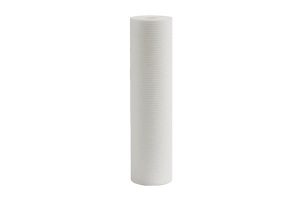
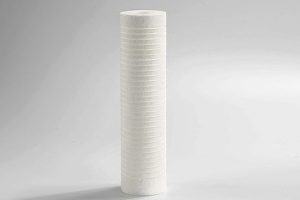
خرطوشة الفلتر المنفوخ بالذوبان من البولي بروبيلين
- Flow Rate:
- 500 GPM
- Micron:
- 5, 10, 25 μm
- Temp:
- up to 80°C
ترست بايلوت
A practical filtration solution for removing suspended solids across a broad range of industrial processes. Melt blown filter cartridges offer 1–100 micron depth filtration, combining stable flow rates with reliable particle capture in a single-piece polypropylene construction.
In-house Lab Testing
ISO 9001 Certified
Global Delivery
Need Help Selecting?
Our engineers can help you choose the right filter for your application
Melt blown filtration is created by extruding molten polypropylene into fine fibers that are layered to form a gradient-density structure. This density transition allows larger particles to be captured near the outer layers while finer contaminants are retained deeper in the cartridge.
Because filtration occurs throughout the media thickness, pressure rise is more gradual over time. Melt blown cartridges are commonly used as economical prefilters in water, chemical, and general process applications.
Need Help Selecting?
Our engineers can help you choose the right filter for your application
نحن أكثر من مجرد مورد - نحن شريكك التقني في حلول الترشيح
قدرات اختبار داخلية للمواد وضمان الجودة مع معدات متطورة وفنيين معتمدين.
وضعك كشريك تقني وليس مجرد مورد. حلول مخصصة لتحدياتك الفريدة من نوعها.
خدمات مجانية شاملة لدعم احتياجاتك من الترشيح دون أي تكاليف خفية.
منشآت تصنيع متطورة مزودة بأحدث مرافق التصنيع مع إمكانات توصيل عالمية ودعم محلي.
A melt blown filter cartridge is a depth filtration device made by heating polypropylene polymer, extruding it through fine nozzles, and using high-velocity air to blow the molten fibers into ultrafine strands of 1-4 microns. These fibers are collected on a rotating spindle to form a gradient structure with loose outer layers and dense inner layers — no adhesives or binders are used at any point in the process.
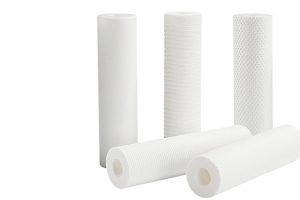
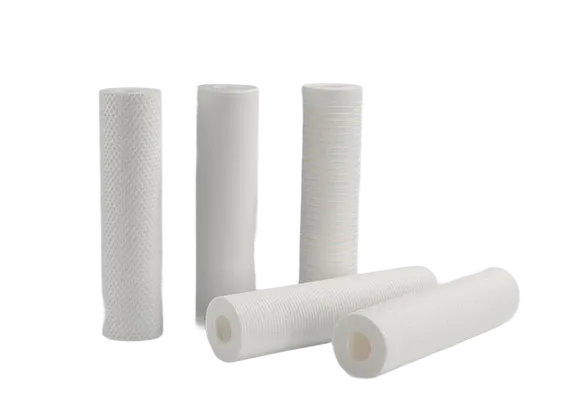
Melt blown filter cartridges come in 5 surface designs, each optimized for a different filtration challenge. The standard PLM-PP is the most cost-effective general-purpose option, while the grooved, orange-peel, mini-grooved, and matte types each address specific performance requirements around dirt capacity, viscosity, accuracy, and clogging resistance.
The gradient structure works by progressively decreasing pore size from the outer surface (loose, 10+ microns) to the inner core (dense, 1-4 microns). Large particles are captured in the outer layer, medium particles in the middle, and fine particles in the inner core — preventing surface clogging and maximizing dirt holding capacity across the full wall thickness.
PP melt blown filters resist acids, alkalis, alcohols, and acetone but are not compatible with benzene or xylene. Nylon melt blown filters handle benzene, xylene, and trichloroethylene but cannot be used with acids. The choice depends on the chemical composition of the liquid being filtered.
Use melt blown for high-sediment pre-filtration where cost and dirt holding capacity are priorities. Use string wound for moderate sediment in low-viscosity liquids, especially where backwashing or high-temperature operation is needed. Use مرشحات مطوية for fine or sterile filtration requiring long service life, low pressure drop, and precise chemical compatibility.
Service life depends on the quality and particle load of the liquid being filtered. In clean tap water, melt blown cartridges typically last 3-4 months. In surface water or RO pre-filtration, expect 1-3 months. Replace when differential pressure reaches 0.2 MPa or when flow rate drops noticeably.
To extend service life, install a coarser pre-filter (20-50µm) upstream or implement two-stage filtration for heavily contaminated water.
Melt-blowing is a polymer extrusion process where molten polypropylene is forced through fine nozzles and blown by high-velocity air into ultrafine fibers of 1-4 microns, which are then collected on a rotating spindle. Because the fibers bond thermally as they cool, the resulting structure requires no adhesives or binders — making the cartridge 100% pure PP and safe for pharmaceutical and food contact applications. The natural density variation during fiber collection creates the gradient structure automatically, without any secondary processing.
No. Melt blown filters are single-use and should not be cleaned or backwashed. Unlike string wound filters which can be backwashed up to 150 times, the gradient density structure of melt blown cartridges degrades when flow is reversed — disrupting the fiber layers, weakening thermal bonds, and risking fiber shedding into the filtered liquid. Given their low unit cost, replacement is more economical than attempting to clean them.
To maximize service intervals, install a coarser pre-filter upstream, monitor differential pressure, and replace at 0.2 MPa.
Choose your micron rating based on the particle size you need to remove and the downstream equipment you are protecting. For RO membrane pre-filtration, 5µm or 10µm is the standard starting point. For pharmaceutical or electronics applications requiring fine pre-filtration, use 1µm or 3µm. For coarse pre-filtration of tap water with visible sediment, 20-30µm is sufficient.
When in doubt, start with a higher micron rating and work down — oversized ratings cause premature loading, undersized ratings cause rapid pressure drop.